
Solo show | Pierre Dumaire
Exhibition
21.02.2026 — 28.03.2026
L'Heure fauve
Opening
21.02.2026 — 14h to 20h
DS Galerie is pleased to announce “L’Heure fauve,” the first solo exhibition by artist Pierre Dumaire at the gallery, curated by Kévin Le Squer, art historian and Head of Exhibitions at the Fondation Carmignac.
The exhibition benefits from the gallery support grant of the French National Centre for Visual Arts (CNAP).
“Lying on the grass, the faun awakens, no longer certain whether he dreamed this moment of ecstasy with the nymphs or not.
In a bedroom, beneath posters and icons pinned to the wall, the back-and-forth movement of a teenage hand reveals a still-timid sexual identity.
Under the eye of the camera, 1970s floral wallpaper seems to blush modestly before a homosexual pornographic scene, while in the distance the forest becomes the intimate cocoon of two men entwined after making love.”
“L’Heure fauve” is Pierre Dumaire’s first solo exhibition, intertwining the intimacy of the bedroom, adolescent fantasy, and cruising grounds in the open air. Nourished by 1980s gay pornographic cinema and by the sensual aura of the faun as performed by Rudolf Nureyev(1)—two themes that inhabit the artist’s work—the exhibition probes the duality of bodies between poetry and animality. Here, time is suspended, images ripple across fabric, men become hazy memories, and representations of nature invade the gallery space.
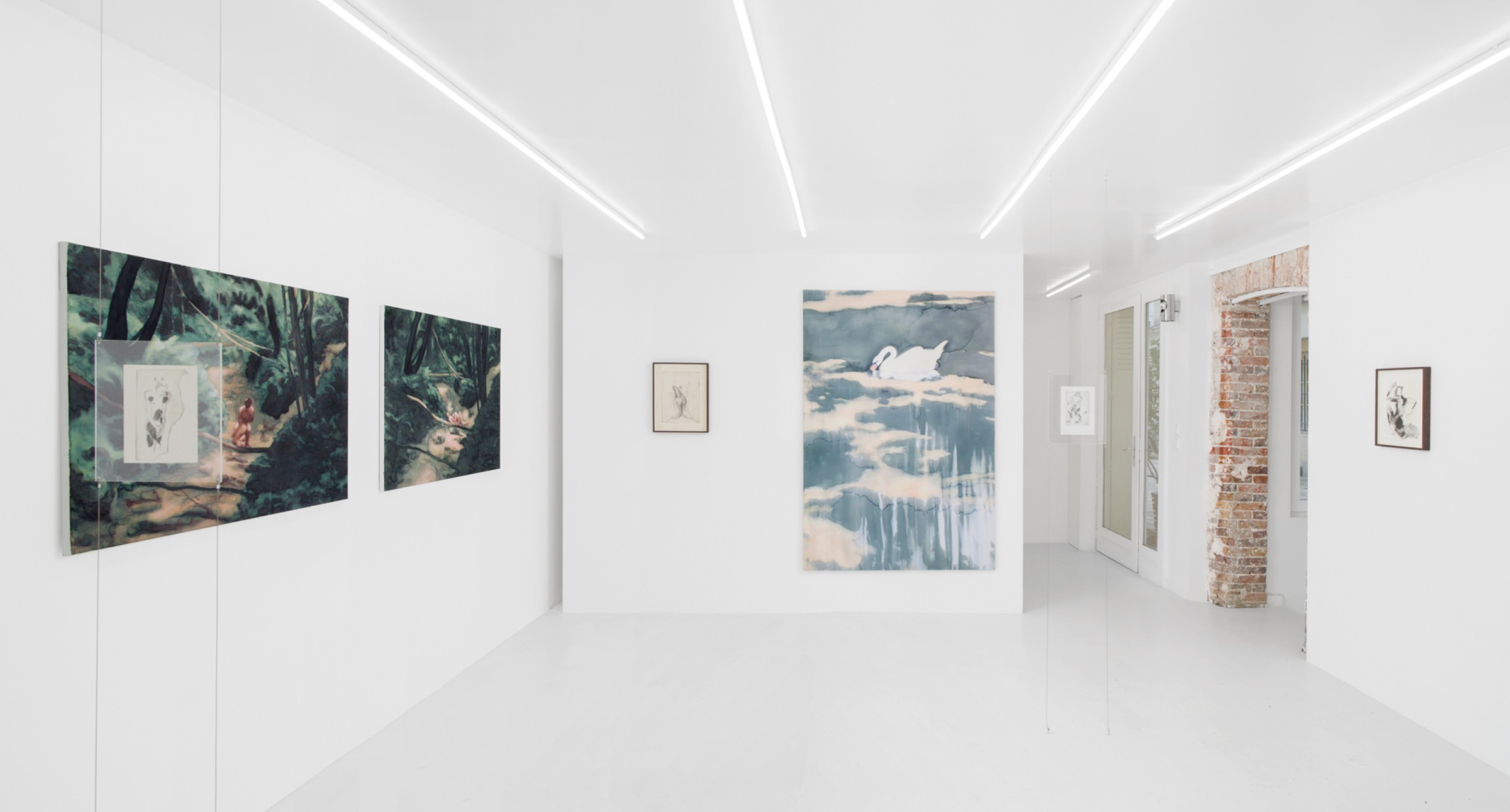
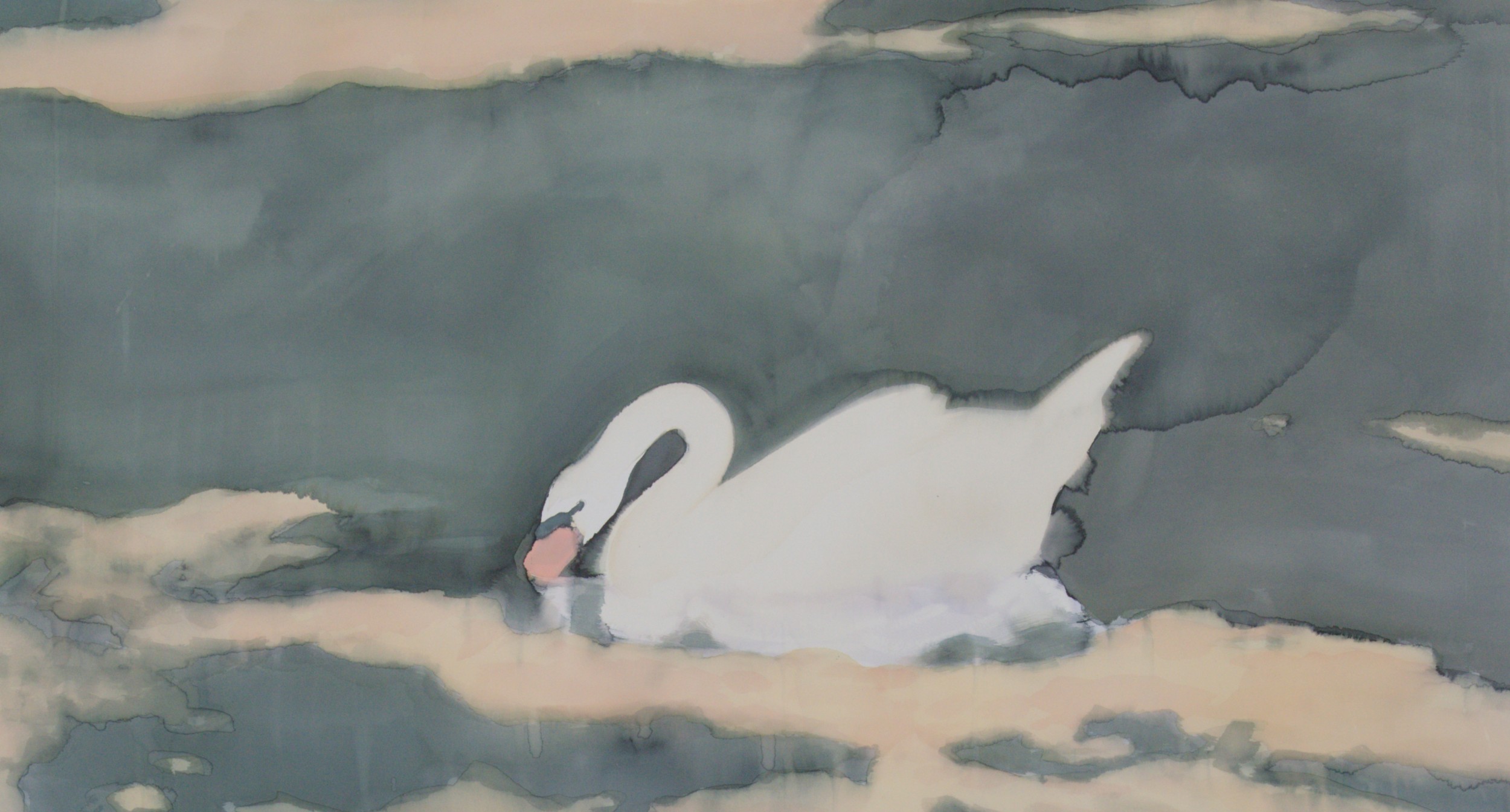
The first canvas that appears depicts a white swan on a lake, painted after a photograph taken by the artist on Donauinsel(2). The bird echoes an afternoon of flirting, encounters, and sex, while the curve of its long neck recalls a phallic form. In Western representations, the white swan is a symbol of beauty, love, and sensuality. It evokes the myth of Leda, the queen seduced by Zeus transformed into the animal, as well as Hans Christian Andersen’s tale(3) recounting the story of a sister seeking to free her eleven brothers turned into swans. In the latter, nature is without equal: the dark forest becomes protective, the sea initiatory, plants healing, and twilight transformative.
This time of metamorphosis, between day and night, permeates the exhibition to the point of giving it its title. L’Heure fauve becomes that moment between dream and reality that releases fantasies and allows one to reveal oneself; a shimmering moment in which man and animal merge in the image of the faun, a ghostly yet guiding figure within the exhibition.
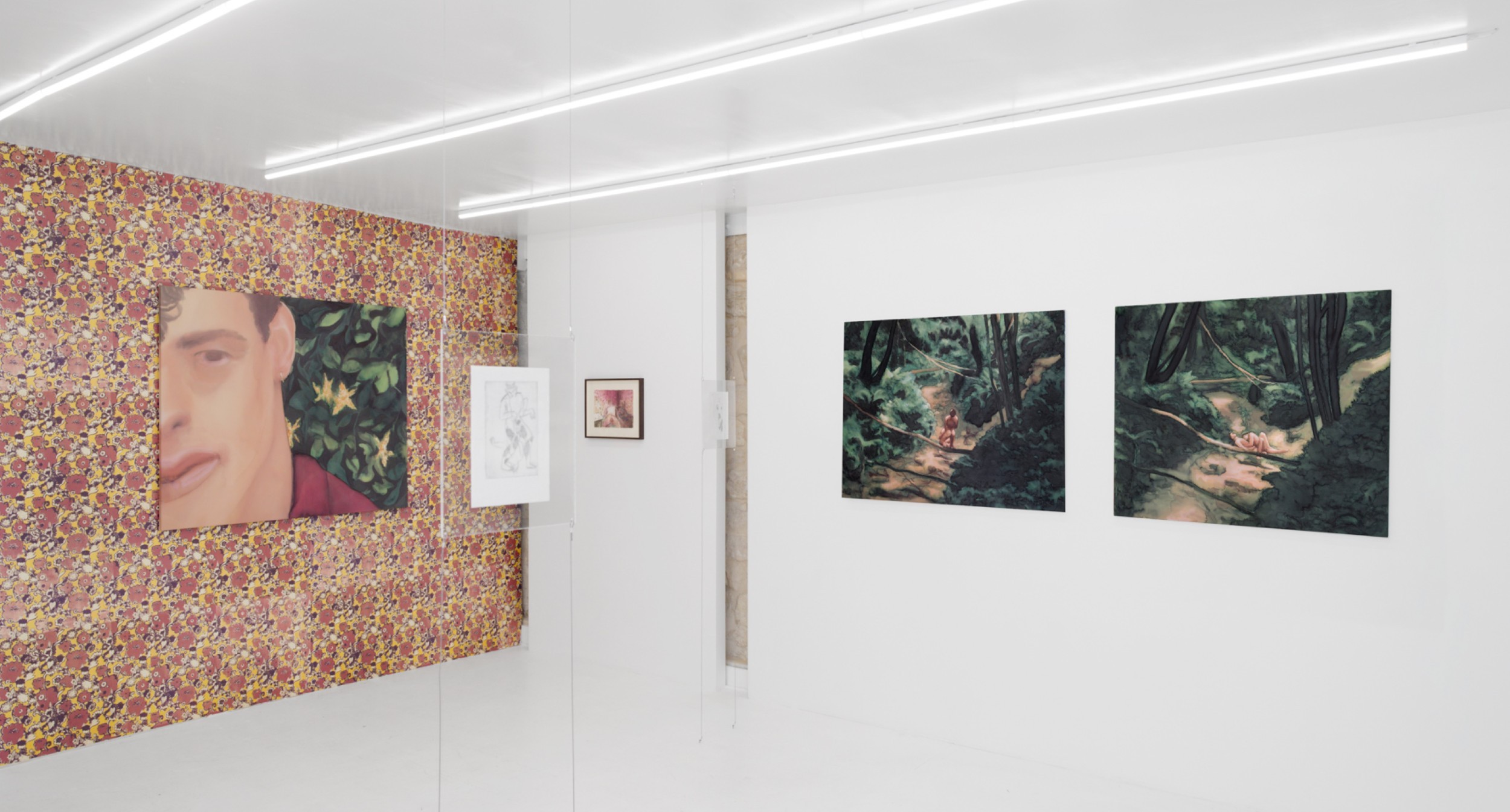
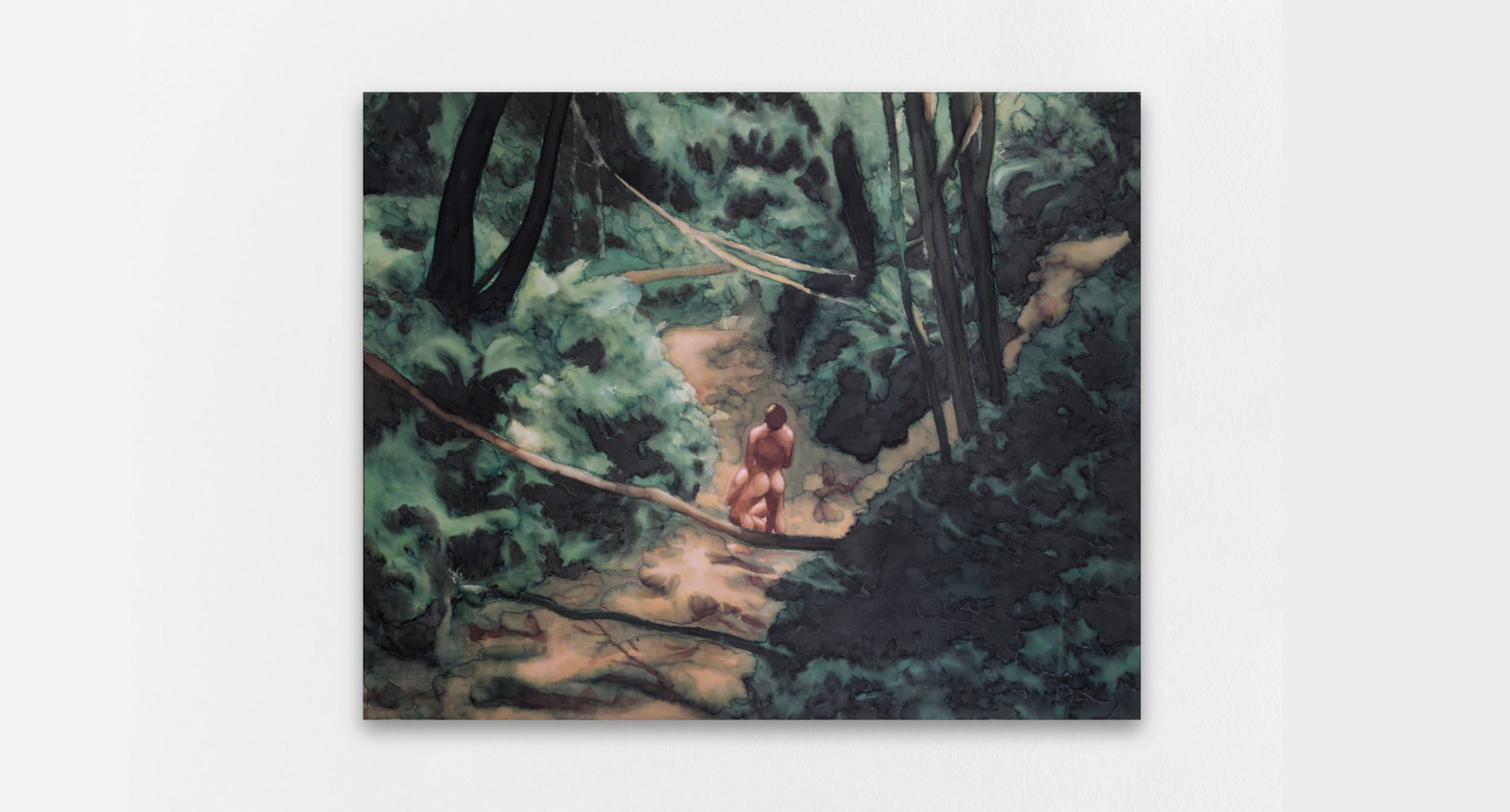
Nature overtakes the memory of flesh while bearing witness to it, as in the two paintings drawn from Wallace Potts’s gay pornographic film Le Beau Mec (1979). In these works, the eye spies, from behind the dense and enveloping forest of the foreground, a couple’s lovemaking. In one painting, a scene of fellatio; in the other, an embrace. A film about the life of a Parisian go-go boy, the story oscillates between documentary and fiction: the raw reality of a boy prostituting himself in his room and this surreal, almost bucolic scene where sex is no longer a commodity but a moment of love and tenderness.
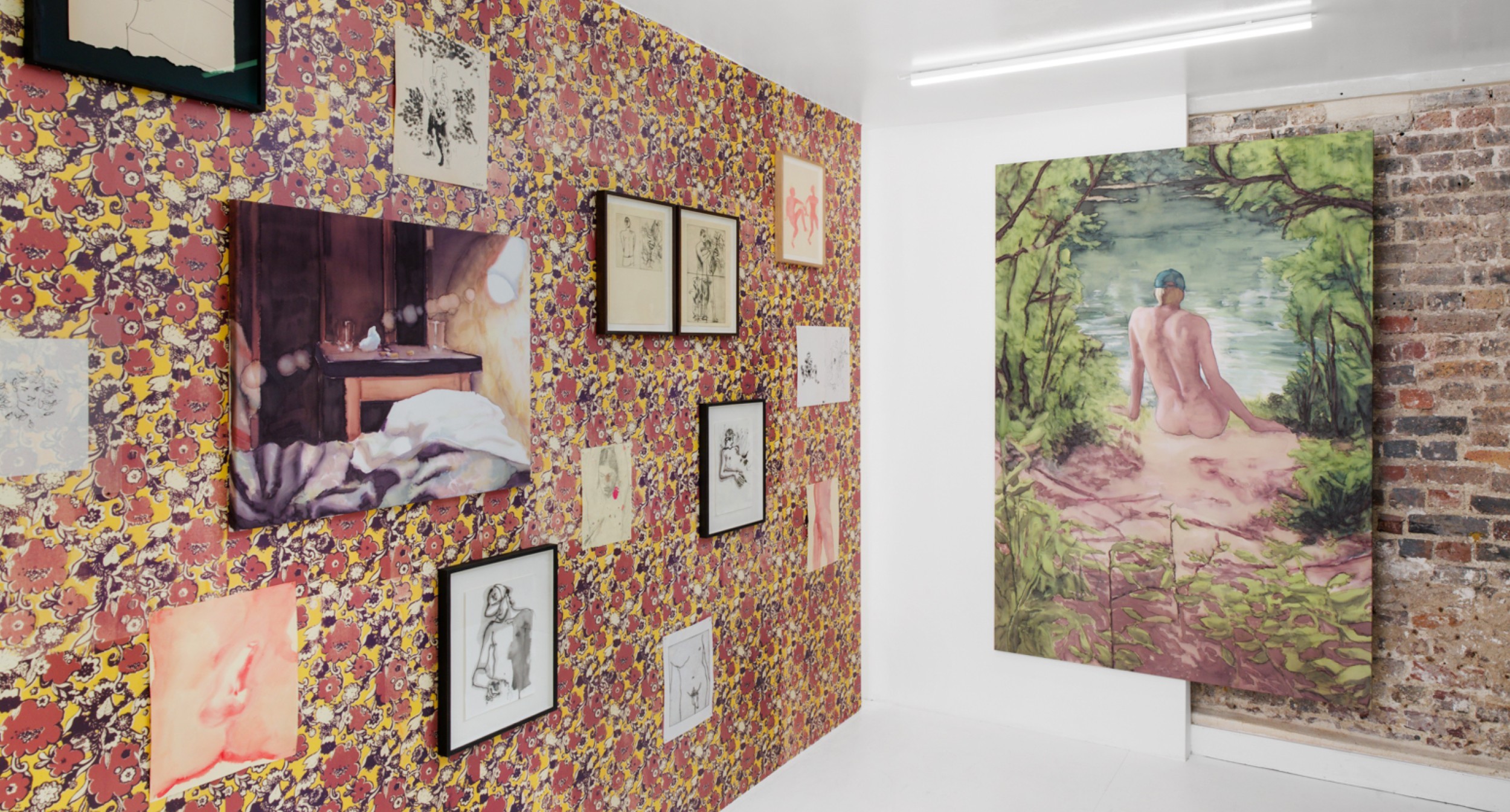
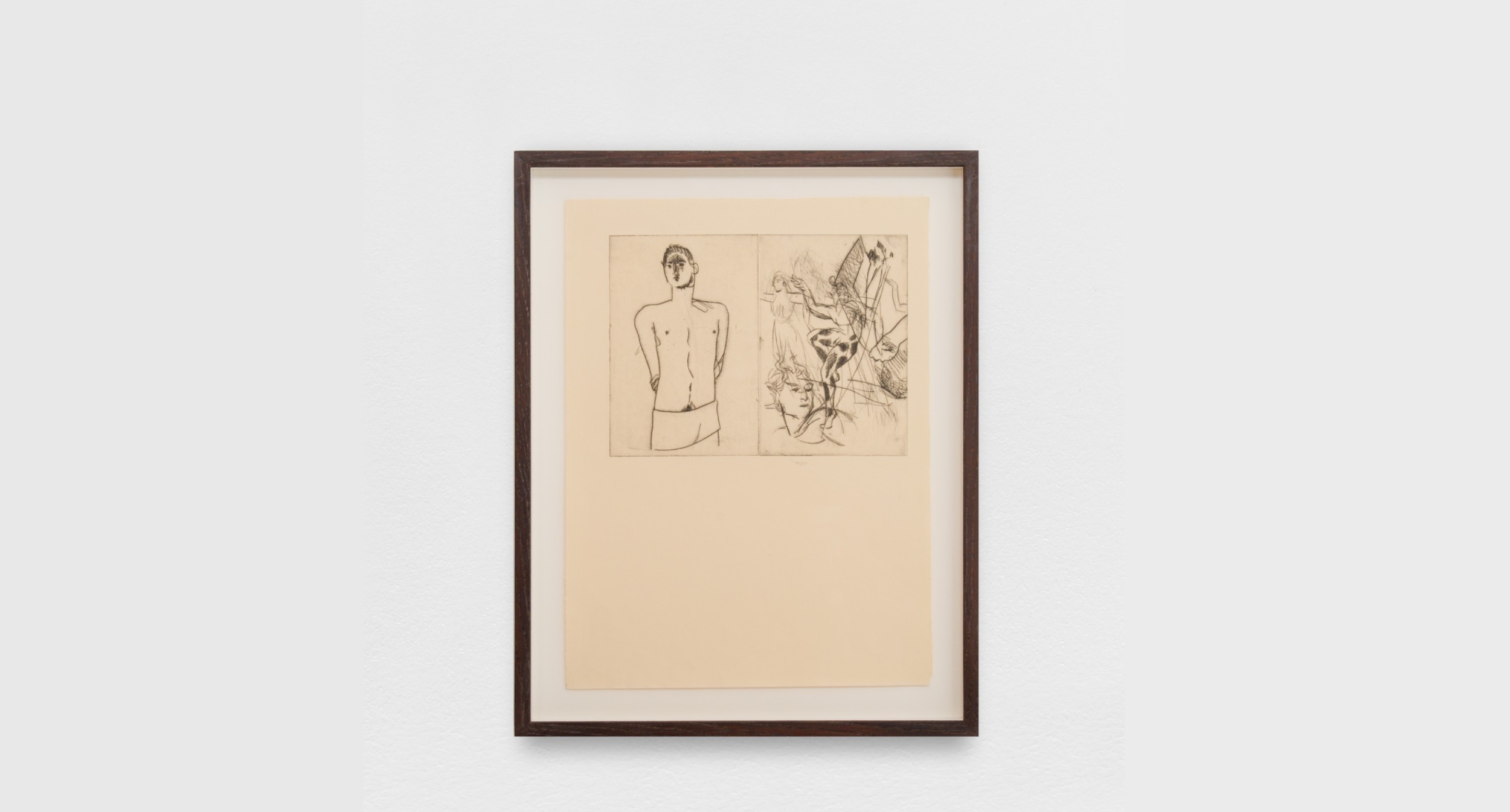
On the other side of the wall, the swan seems to have transformed. The lake is the same, but the subject has shed its beautiful plumage to reveal itself—naked, languid. The curve is no longer that of its long neck but that of its hips. He waits at the water’s edge, like the thousand-times-depicted image of a nymph by her lake. Metamorphosis is no longer an act of deception to conceal oneself but a revelation, to oneself and to the other. A self-portrait of the artist on Donauinsel, he confronts a wall composed of sketches, engravings, and other drawings surrounding a painting of an unmade bed. The composition here recalls the icons that adorn teenagers’ bedrooms, pinning up inspiring, fantasized figures—an innocent reflection of their identity construction. We enter the artist’s intimacy, visualizing images that shape him. Pierre Dumaire explains that his understanding of himself, of his homosexuality, came through discovering pornography in the 2000s. On this wall: preparatory drawings for his paintings, his first self-portraits in cruising sites made for the exhibition, the faun.
The wallpaper in the background imitates the pattern found in the pornographic films the artist watches and from which he draws inspiration. Here, the décor of a family memory becomes animal, and wild nature a temple of intimacy. The cruising site is no longer only a hunting ground where men size each other up, but also becomes a space of flourishing. The duality between spaces blurs: behind the flowers on condom wrappers, pistils transform into anuses. Rosebud.
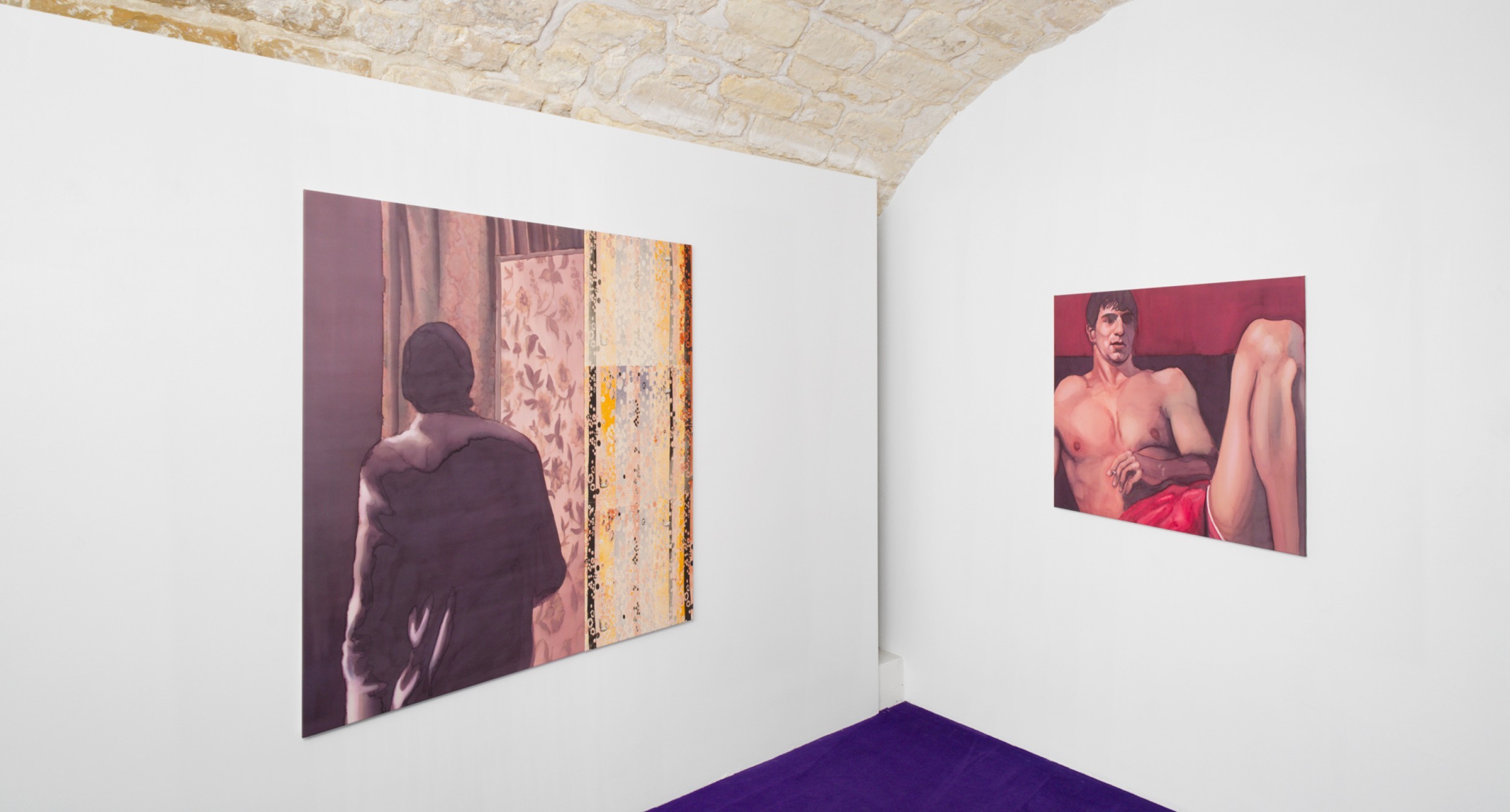
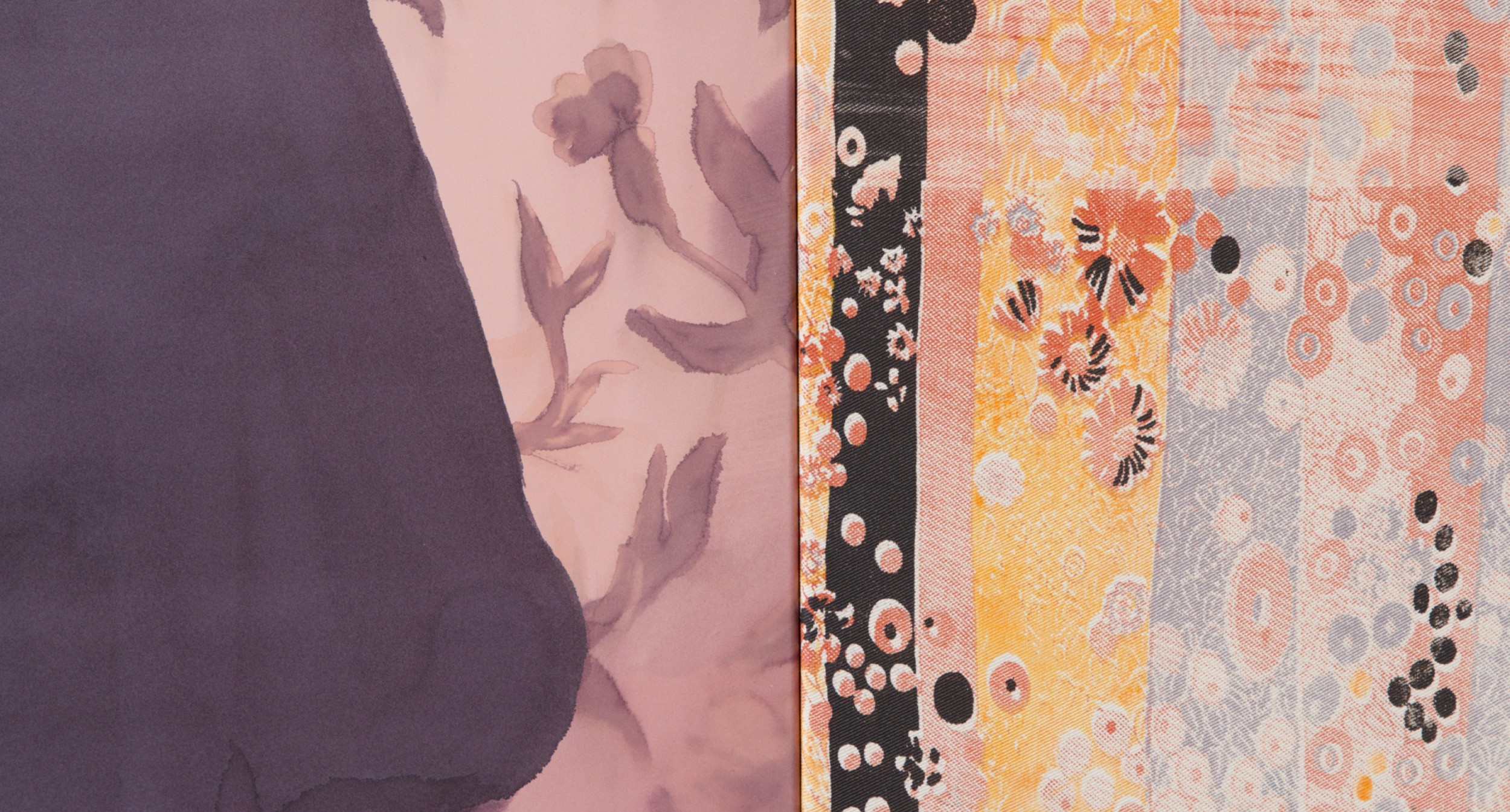
Finally, recurring works in Pierre Dumaire’s practice, the polyptychs combining painting on fabric and silkscreen underscore the duality animating the exhibition. Scenes drawn from Patrice Chéreau’s film L’Homme blessé (1983) show the protagonist cornered in a room, his face—again framed by floral wallpaper—frightened, like prey facing its destiny. The shot is tight, leaving room only for palpable anxiety and the motifs of a perverted domestic interior. The pretty wallpaper becomes the backdrop to a wild scene, a raw and illicit sexual encounter within this setting and at that time.
Softness and violence confront one another, the forbidden and the permitted intertwine, man and animal become one; once again, the figure of the faun watches over us. As with Mallarmé(4), we are invited into a universe where duality reigns, where metamorphosis is inevitable and where dream and reality dissolve into one another.
—
(1) L’Après-midi d’un faune, choreography by Vaslav Nijinsky (created in 1912 for the Ballets Russes, music by Claude Debussy, after the poem by Stéphane Mallarmé), revived by Rudolf Nureyev for the Royal Ballet, London, 1967.
(2) Cruising site in Vienna, Austria.
(3) Hans Christian Andersen, Legends and Tales – Andersen’s Fairy Tales, trans. Anne-Mathilde Paraf, illustrated by Jiří Trnka, Paris: Éditions Gründ, 1991, pp. 140–153.
(4) Stéphane Mallarmé, L’Après-midi d’un faune. Églogue, Paris: Alphonse Derenne, 1876.”
Exhibition text by | Kévin Le Squer
Trained at the École des Beaux-Arts de Paris, the Akademie der Bildenden Künste in Vienna, and the École Duperré, Pierre Dumaire develops a pictorial practice that explores ambiguous spaces, traversed by latent narratives and a tension between visibility and concealment. Drawing on an iconography rooted in gay visual culture, his work is characterized by the use of painting on silk, silkscreen, and printmaking, lending the works a melancholic and expressive tone.More info
An art historian specializing in contemporary art, Kévin Le Squer is Head of Exhibitions and Off-Site Curator at the Carmignac Foundation. He has been involved in the development of exhibitions and publications at the Villa Carmignac since 2019 and served as associate curator of the exhibition “The Infinite Woman” in 2024, alongside Alona Pardo. Since 2022, he has curated a parallel program for the Foundation, consisting of artistic invitations for project spaces and performances. He previously worked on the conception of the exhibition “Olafur Eliasson, Objects Defined by Activity” at the Espace Muraille art center in Switzerland (2018) and was in charge of cultural programming at the Musée d’Art Moderne de Paris (2016–2017).
L’Oeil de Sloft, March 2026
Pierre Dumaire : rêveries nocturnes et métamorphoses à la DS Galerie
Read the article
DOCENT, March 2026
Pierre Dumaire “L’Heure fauve” at DS Galerie, Paris
www.
The Steidz, February 2026
Pierre Dumaire s’expose à l’heure fauve by Maxime Gasnier
Read the article
Contemporary Art Library, February 2026
Pierre Dumaire “L’Heure fauve” at DS Galerie, Paris
www.
Mousse Magazine, February 2026
“L’Heure fauve” at DS Galerie
www.